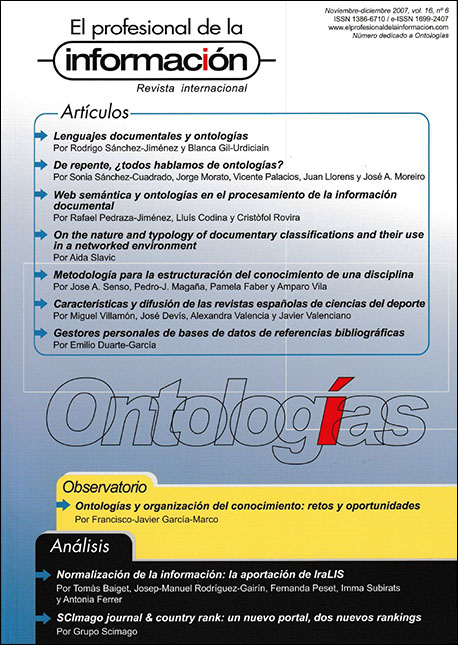
On the nature and typology of documentary classifications and their use in a networked environment
DOI:
https://doi.org/10.3145/epi.2007.nov.05Palabras clave:
Esquemas de clasificación, Clasificación documental, Clasificación bibliotecaria, TipologíaResumen
Los estándares para publicar e intercambiar vocabularios enfocados en la Red, así como las propuestas para servicios y registros de terminología, pueden mejorar el intercambio y uso de todos los sistemas para organizar conocimientos en red. Esto significa que las clasificaciones documentales también pueden resultar más útiles fuera de su aplicación original. En este trabajo se resumen unas características típicas de clasificaciones documentales y se explican aspectos de terminología, función y realización. El concepto original de cada esquema de clasificación determina las funciones para las que el vocabulario está diseñado. Estas funciones influyen sobre la estructura, semántica y sintáctica, así como la cobertura de esquemas y formato en el cual los datos de clasificación se publican y se hacen accesibles. El autor sugiere que hay que prestar atención a las diferencias entre clasificaciones documentales porque pueden determinar su encaje para un fin específico y pueden imponer requisitos distintos a su uso online. Cuando hablamos creamos muchas clasificaciones para organizar conocimientos y puede ser importante promocionar una mayor pericia del dominio bibliográfico respecto a la construcción y uso de sistemas de clasificación.
Descargas
Descargas
Publicado
Cómo citar
Número
Sección
Licencia
Condiciones de difusión de los artículos una vez son publicados
Los autores pueden publicitar libremente sus artículos en webs, redes sociales y repositorios
Deberán respetarse sin embargo, las siguientes condiciones:
- Solo deberá hacerse pública la versión editorial. Rogamos que no se publiquen preprints, postprints o pruebas de imprenta.
- Junto con esa copia ha de incluirse una mención específica de la publicación en la que ha aparecido el texto, añadiendo además un enlace clicable a la URL: http://revista.profesionaldelainformacion.com
La revista Profesional de la información ofrece los artículos en acceso abierto con una licencia Creative Commons BY.